
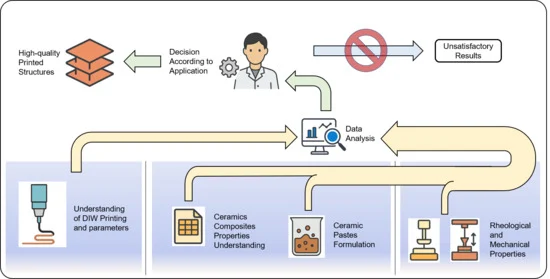
In additive manufacturing technologies, the use of pastes and inks based on materials such as clay to create three-dimensional objects layer by layer has opened new possibilities in fields such as engineering and biomedicine. This review article aims to provide a comprehensive understanding of 3D printing of ceramic pastes through Direct Ink Writing (DIW), also referred to as Robocasting. DIW offers specific advantages for ceramic 3D printing, including the ability to extrude highly loaded pastes with customized rheological properties to accommodate a broad spectrum of ceramic compositions, varying from conventional clays to advanced ceramics. It is characterized by filament deposition control, which facilitates the fabrication of complex, porous, or customized architectures while simultaneously minimizing material waste. Through a bibliometric analysis of the literature published between 2020 and 2024, the most relevant studies regarding printing system architectures, ceramic paste formulations, and adjustment of parameters to obtain high-quality parts were identified. This work presents relevant and accurate explanations of the DIW technology, supporting researchers and industry professionals seeking to initiate or improve ceramic 3D printing processes for a wide range of applications.
Pour en savoir plus : Additive Manufacturing of Ceramic Materials via Direct Ink Writing
