
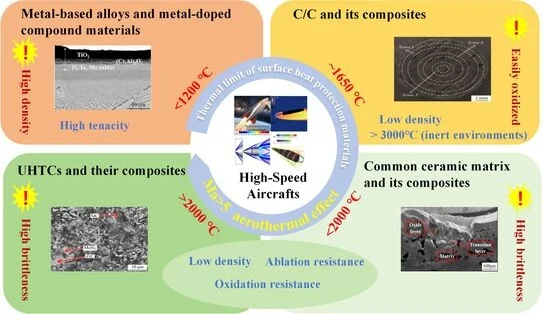
During high-speed flight, intense friction on the aircraft surface always occurs due to atmospheric fluid medium. The resultant high frictional drag will trigger a significant aerothermal effect, and thus raise the surface temperature sharply to 1000–3000 °C. This extreme heat not only remarkably reduces the aerodynamic efficiency but probably also causes thermal failure of the structural integrity and damage of internal components. Therefore, robust heat-resistant materials are the preferred choice for designing high-speed aircraft due to their benign tolerance to high temperature, oxidation and ablation as well as large strength and durability. This work systematically unveils the generation mechanism of frictional drag in high-speed flight and introduces the characteristics and applications of typical thermal insulation materials (TIMs). After that, the recent progress in a thermally protected material system including metal-based alloys and metal-doped compound materials, ultra-high-temperature ceramics (UHTCs), carbon (C)/carbon (C) and C/SiC composites, ceramic matrix composites (CMCs), UHTCs-modified C/C and C/SiC composites is conducted. Finally, the current technical bottlenecks are discussed, simultaneously proposing the development direction of novel TIMs for the potential applications for high-speed aircrafts.
Pour en savoir plus : Research Progress on Thermal Insulation Material Systems for High-Speed Aircrafts
