
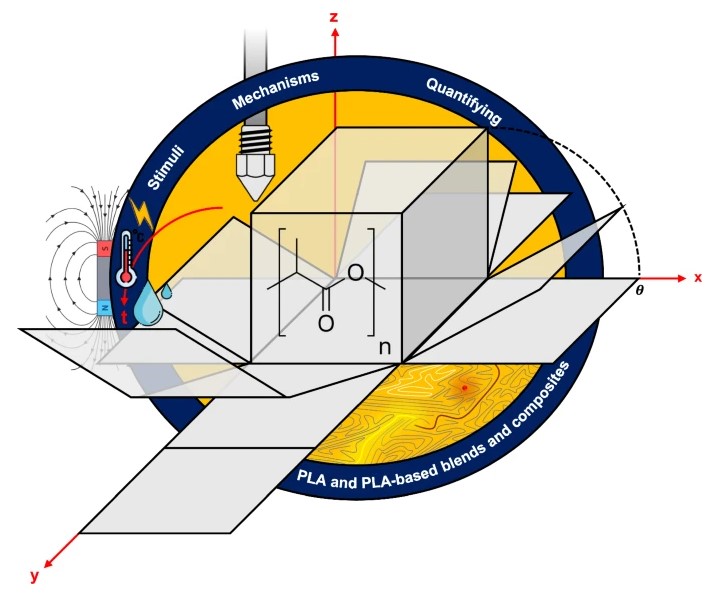
4D printing, as an advancement in additive manufacturing, incorporates smart materials that allow printed objects to experience programmed shape changes over time when exposed to specific external stimuli. Polylactic acid (PLA) stands out among these materials because of its biodegradability, robust mechanical properties, ease of processing, and versatility with a range of reinforcement approaches. This review investigates the potential of PLA and PLA-based blends/composites for 4D printing applications, with a particular focus on their thermal, mechanical, stimuli-responsive, and functional properties, as well as the manufacturing techniques and programming methods employed to achieve these advanced materials. Additionally, a range of modification approaches, including the incorporation of polymers, fibers, particles, and bioactive materials, are discussed with respect to their role in enhancing the functionality of 4D-printed PLA-based structures for biomedical, aerospace, automotive, and robotics applications. The mechanisms governing the shape memory effect in these materials, including the dual-state mechanism, dual-component mechanism, and partial-transition mechanism, are reviewed in detail. A comprehensive overview of recent advancements, existing challenges, and future perspectives is provided, with particular focus on material selection strategies for PLA-based systems aimed at achieving targeted functionalities in next-generation 4D-printed smart materials.
Pour en savoir plus : Review: 4D printing of PLA and its blends/composites: technologies, mechanisms, characterization, and applications
