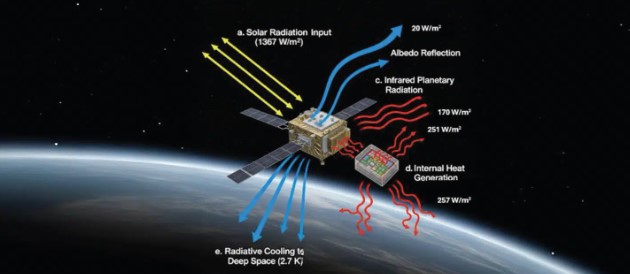
Extreme conditions in interplanetary environments, like lunar night at -173°C and Martian dust storms, require new thermal control systems that go beyond traditional electronics cooling approaches. Martian dust consists primarily of iron-oxide and silicate particles with diameters ranging from 1 to 3 μm. These particles are electrostatically adhesive, capable of embedding into coatings, degrading surface optical properties, and reducing radiator performance by 20–40% during storms. This review proposes quantitative frameworks for managing temperature swings greater than 300°C in vacuum environments where convection is absent. New developments include variable emittance radiators (ε = 0.1-0.9), carbon nanotube-enhanced phase change materials with 50 W/ mK thermal conductivity, and loop heat pipes with 10,000 W/ mK thermal conductivity. Mathematical models for junction temperature management, Arrhenius-based battery degradation, and multi-nodal thermal networks are useful design tools for harsh environments. Electrodynamic dust mitigation and thermal interface materials with 0.05 cm²·K/W resistance after 5000 cycles provide solutions for extreme environments.
Spacecraft Thermal Control in Extreme Environments: Surviving Lunar Night and Martian Dust